Shopify’s agent‑commerce category filter didn’t filter on any of 190 stores
The endpoint declares a category filter in its published schema. We sent one to 200 live storefronts. Not one of them narrowed a result set by it.
The endpoint
As of 2 September 2026, every Shopify store answers an agent-commerce endpoint at
POST /api/ucp/mcp, advertised at GET /.well-known/ucp, speaking
the Universal Commerce Protocol. Shopify documents it as
its Storefront MCP server, implementing the
protocol’s Catalog capability (read 3 September 2026). Merchants did not switch
it on and it is not in their admin. It exists so an AI shopping agent can ask a store for
its catalogue directly instead of scraping the HTML, and it returns clean structured
data: price as an integer in minor units with a currency code, variants, SKUs, media,
canonical URLs, and a Shopify taxonomy category per product.
It is a JSON-RPC tools/call against a tool named
search_catalog. The interesting argument is catalog, and inside
it, filters.
What the schema says
Fetch the tool list from any store and search_catalog declares, among
others, catalog.filters.categories — an array of strings, documented
as “category filters combined with OR logic” — alongside
catalog.filters.price.{min,max} as integers in minor currency units.
The store is not inventing that. The protocol’s own
catalog search specification, version dated
25 August 2026, defines filters.categories as an array of strings
that “filter by product categories (OR logic — matches products in any listed
categories)”, and filters.price.min and .max as amounts in
ISO 4217 minor units; its MCP binding names the tool
search_catalog and puts those filters under catalog.filters.
Shopify’s developer documentation for the
same server says the tool can “filter by categories or price range (in minor
currency units)”. Both read 3 September 2026. So the filter is declared by the
store, specified by the protocol and documented by the platform; what follows is what it
did.
So an agent is plainly meant to be able to say show me your running shoes and get running shoes. We were about to write a paragraph about what it costs a merchant to leave the category field blank, given that. Then we tried it.
Method
200 stores, drawn deterministically from a corpus of 10,099 known Shopify storefronts — sort the hostnames, take every Nth — so the sample is reproducible and nobody has to take “we picked 200 stores” on trust. Run on 2 September 2026. Each store got the same sequence of calls, 10 products requested every time:
| # | Call | Filter sent | What a working filter does |
|---|---|---|---|
| 1 | Control | none | returns products |
| 2 | Impossible category | gid://shopify/TaxonomyCategory/zz-99-99-99 | returns nothing — no product is in it |
| 3 | The store’s own category | a category the control’s own products carry | returns something — at least the product we took it from |
| 4 | Same, unwrapped | the bare id without gid://… | the other form an agent would reasonably try |
| 5 | Price control | price.max = 1 | returns nothing — nothing costs a cent |
Calls 2 and 3 are the experiment and they are only meaningful together. An earlier four-store version of this ran call 2 alone, and call 2 alone cannot tell the filter is ignored from the filter rejects everything. Those are opposite findings and, as it turns out, both happen.
The query matters more than it looks. A first attempt used generic words —
“gift”, “set”, “new” — and produced numbers
that were measured honestly and were still wrong: a bad query surfaces a catalogue’s
odd corners rather than its catalogue. Every query here is three words taken from one of
the store’s own product titles, read from its public
/products.json.
Result
190 stores answered
What the store did with filters.categories | Stores |
|---|---|
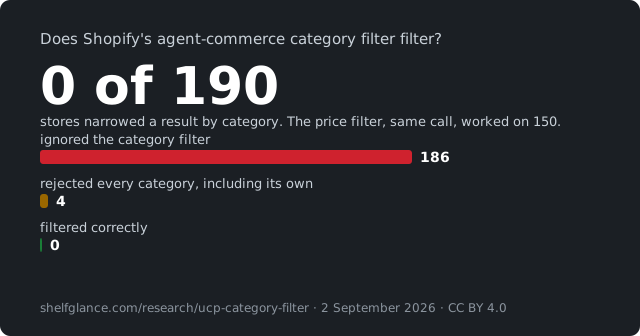
| Ignored it — the impossible category returned the full unfiltered set | 186 |
| Rejected everything — returned zero for every value, including the category its own products carry | 4 |
| Filtered correctly — impossible category empty, own category not | 0 |
Of the 200 sampled, 10 could not be read: eight served no product feed to build a query from, two matched nothing for their own product title.
177 of the 190 returned at least one product carrying a taxonomy category, so this is not a story about missing data. The category is there. The filter does not use it.
The control, which is the whole reason this is publishable
A null result is worth nothing unless you can show the request worked. Ours is
price.max, sent in the same envelope to the same store with one field
changed.
- On 150 of 190 stores, a
price.maxof one cent correctly returned nothing. - On 148 stores the very same request that honoured price ignored the category.
One field in filters moves the result and the other does not, in the same
call, on the same store. That is the finding. If nothing had moved, the correct
conclusion would have been that we were sending it wrong.
The mistake we made first
The first full run of this reported 177 stores refusing the request outright, and it was about to be written up as a discovery. It was our bug.
A product comes back with
categories: [{"value": "gid://shopify/TaxonomyCategory/hb-3-2-1-1", "taxonomy":
"shopify"}]
— objects. filters.categories is declared as an
array of strings. We were passing the object straight back in, violating the
endpoint’s own schema, and calling its entirely correct refusal a finding about
Shopify.
Taking .value fixed it, and call 4 above exists because of it: if neither
the wrapped identifier nor the bare one narrows anything, “you sent it wrong”
stops being available as an explanation. We are describing this at length because it is
the exact failure this kind of post usually ships with, and the only defence against it
is publishing the rows.
What this does and does not mean
It does not mean an uncategorised product is invisible to agents. That was the sentence we expected to be able to write and it is not true — nothing is being filtered out of anything, so a blank category excludes you from nothing.
It does mean an agent cannot narrow a catalogue search by category today, whatever the schema says, on any of the 190 stores we could read.
It is not a complaint about Shopify. UCP shipped in 2026, and the specification we read is dated 25 August 2026, eight days before this reading. A schema arriving before every part of its behaviour does is ordinary, and this is a young protocol doing a hard thing. The useful lesson is narrower and older than agentic commerce: test what an endpoint does rather than reading what it declares.
Reproduce it
One store, one call, no tooling. Pick any Shopify domain:
curl -s https://EXAMPLE.com/api/ucp/mcp \
  -H 'Content-Type: application/json' \
  -d '{"jsonrpc":"2.0","id":1,"method":"tools/call","params":{
        "name":"search_catalog",
        "arguments":{"catalog":{"query":"YOUR QUERY","filters":{
          "categories":["gid://shopify/TaxonomyCategory/zz-99-99-99"]}}}}}'
Run it with and without the filters block and compare the counts. Note
that calling the endpoint requires serving a UCP platform profile the store can fetch;
ours is at /ucp/agent-profile.json and declares empty
payment_handlers, because a scanner takes no payments.
All 190 readings, one row per store: filter-survey.csv — store, query, products returned for each of the five calls, and the verdict. Every row names a domain you can re-run yourself, which is the point of publishing it.
Reuse the figure
CC BY 4.0. The image is served from here and carries its own source line; the snippet wraps it in a link back to this page.
Who ran this
Shelfglance, which measures what AI assistants can read from Shopify storefronts and keeps a public directory of 10,099 of them. This study came out of trying to write an honest sentence about what a blank category field costs a merchant, discovering the obvious sentence was false, and deciding to publish the reason rather than the sentence. The merchant-facing version of the same finding is here.